Flexible demand access permits: what do they mean for your projects?
Since 1 September 2026 there is an alternative to refusal when the grid has no capacity: the flexible access permit. We break down the CNMC resolution, its four permit types and how they change the valuation of storage projects.
Flexible demand access permits have been a reality since 1 September. But assessing their implications is still a challenge.
If, over the last 12–24 months, you have tried to originate a storage project, connect an industrial electric boiler or develop a data centre, the constraint you most likely ran into was the grid:
"No capacity available."
The first demand capacity maps showed 83.4% of distribution nodes (>1 kV) with no available capacity, and Red Eléctrica found headroom for new demand at only 25% of transmission nodes.
On 1 September 2026, however, an alternative to refusal was created: the flexible access permit, regulated by the CNMC Resolution of 31 July 2026 (BOE-A-2026-17571).
Connecting, yes. But without a guarantee of supply in every hour of the year.
The resolution turns flexibility into a condition of grid access. For storage, it is also an obligation with a deadline.
The technical design is tiered and detailed, but risk allocation is asymmetric. The permit holder accepts restrictions without prior notice in some types, without compensation, without any discount on network tolls and with no defined path towards firm capacity. Meanwhile, the rules that would make it possible to bound that risk are still being drafted.
Until those rules arrive, the recommendation is not to assume, but to model: the zone's pattern, the elements identified in the preliminary proposal, the type chosen and the asset configuration all change how assets are valued.
This article takes the regulation apart piece by piece: where it comes from, how each permit type works, what it requires of the permit holder, how it affects batteries, hybrids and industrial consumers, and which questions remain unanswered.
Starting point and need
Once grid operators began publishing demand access capacity more transparently, an urgent problem became clear: most nodes appeared as congested. This blocks the origination of new projects and slows the arrival of new industry and storage.
At the same time, the data on actual grid utilisation (still not very transparent) showed that the distribution grid was in fact being used well below its nominal capacity.
On top of that, two main catalysts forced a rapid search for solutions to this problem:
- The drive to electrify and reindustrialise the economy, at a time when electricity prices are more competitive than in other parts of the European Union, making productive investment attractive.
- The need to integrate storage technologies (batteries, pumped hydro, thermal storage and hydrogen), a key element for increasing the system's flexibility and thereby supporting the integration of an even higher share of renewables.
Let's look at this context and need in a little more detail.
Why is there, in fact, spare grid capacity almost all year round?
A firm permit requires the grid to meet security criteria both with all its elements available and with one of them out of service (N-1). Sizing the grid for this "worst possible case" leaves capacity idle most of the time.
To give a concrete, easy-to-understand example:
Imagine a household consumer on a 2.0 TD tariff with a peak power of 7 kW. That consumer is "reserving" 7 kW of distribution grid capacity. This means the grid allows them to consume up to 7 kW all year round, at any time (even if a nearby transformer fails).
All of this with a guarantee of supply. Because the grid does not know, and should not need to know, when that consumer might want to take a hot shower, charge their electric vehicle and put a cake in the oven at the same time.
In reality, however, that consumer, like everyone else, practically never reaches or exceeds the 7 kW of contracted peak power. Their average consumption is more like 1–2 kW.
Physical saturation and administrative saturation
Not all constraints are technical. After publishing its demand capacity listings, Redeia argued that the transmission grid cannot be considered collapsed, since capacity has been granted to a very significant number of consumers. In fact, demand pending connection to the transmission grid alone could represent a 25% increase on the country's current electricity demand.
Grid saturation is therefore the sum of technical constraints and the problem of permit hoarding, which Redeia and the Ministry have spoken about openly.
That is why RDL 7/2026 introduced interim milestones for demand permits that have not yet signed an access contract, in the hope of forcing "speculators" who hoard access rights without a real project to give up their permits: payment of 10% of the grid position at 12 months, commissioning of the project design at 3 years and a technical access contract at 4 years. It also introduced a capacity reservation charge for demand connected at 1 kV or above.
Flexible access is the third lever: it does not free up idle permits, but it makes better use of the grid that already exists.
Regulatory framework and timeline
Flexible permits are rooted in Directive (EU) 2019/944 on common rules for the internal market for electricity. Specifically, in Article 6a, which requires flexible connections to be offered in congested areas, and which was introduced by Directive (EU) 2024/1711 on the reform of electricity market design.
Competence within the Spanish regulatory framework comes from Article 33.11 of Law 24/2013 on the Electricity Sector, which tasks the CNMC with approving, by circular, the methodology and conditions for access and connection.
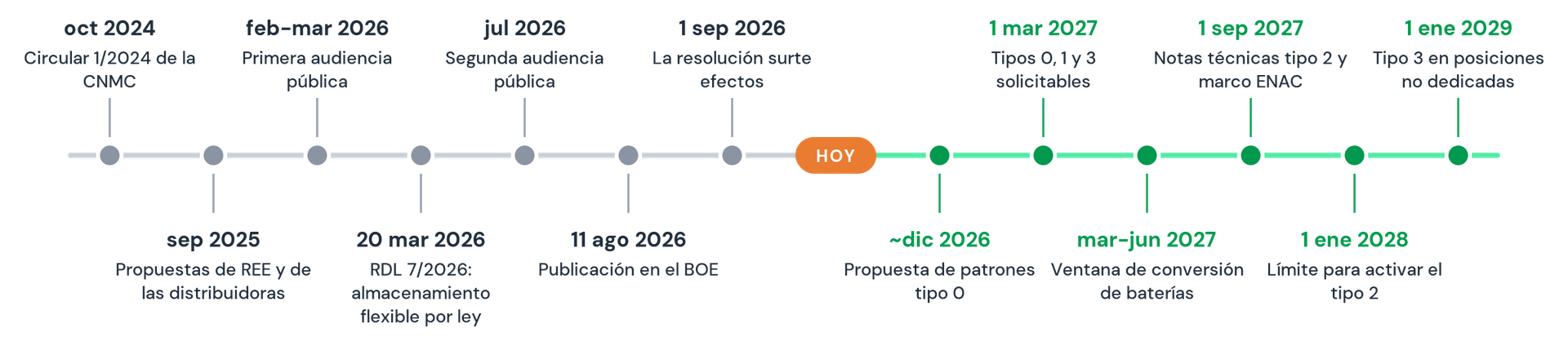
The key piece is Circular 1/2024 of 27 September (BOE of 11 October 2024) on access and connection of demand facilities. Three of its articles underpin everything that follows:
- Article 3: defines flexible access capacity.
- Article 6.1.a: the provision the resolution refers to in order to limit consumers' flexible capacity to nodes without firm capacity.
- Article 18 and the fourth additional provision: the CNMC defines the types through detailed specifications, and distribution system operators had to propose a distribution operating procedure for managing congestion.
Two earlier specifications build on this framework: the Resolution of 8 June 2025 (firm demand capacity in distribution, BOE of 18 June) and the Resolution of 1 December 2025 (demand capacity in transmission, BOE of 10 December), which already treats storage access to the transmission grid as flexible.
The July 2026 resolution (case RDC/DE/003/25) completes the puzzle for flexible capacity.
How does flexible access work?
Before going into each type, these are the common rules set out in the first operative provision of the resolution:
- Subsidiary for consumers. Flexible capacity is only granted to a consumer when there is no firm capacity at the node. It is not a cheap option to be picked à la carte.
- The default for storage. Under RDL 7/2026, storage demand applications are assessed as flexible.
- Nuances for behind-the-meter storage and auxiliary consumption. A consumer can have batteries within its internal network without losing its status as a consumer. And generation and storage facilities can apply for a firm permit for their auxiliary services (Article 5.3 of Royal Decree 88/2026).
- Exclusions. Flexible access cannot be requested by collective urban development and industrial projects required to meet electrification levels, by essential supplies under Article 52 of the Electricity Sector Law, or by facilities required to have a complementary back-up supply.
- The applicant chooses; the operator can counter-propose. The application states the type and, for Type 0, the pattern (application forms must include a specific field for this). The operator may propose a different type or pattern, with justification, if it considers it a better technical solution.
- Changes of type after award. The permit holder may request a change of type or pattern, but subject to the priority order of other applications and following an analysis by the operator.
- No compensation for disconnections or limitations. In all types, limitations and disconnections do not count as interruptions for quality-of-service purposes and do not give rise to any right to compensation.
- Revocation. Failure to meet the conditions may lead to the permit being revoked (Article 8.2 of Circular 1/2024), under terms to be set by a later resolution on non-compliance.
- No route from firm to flexible. The CNMC's explanatory report specifies that applicants will be those needing a new supply or an extension of an existing one, and that converting a firm permit into a flexible one is not envisaged. Releasing firm capacity to relieve a node is deferred to future local flexibility markets.
Which types of demand permits can coexist at the same connection point?

The 4 types of flexible permits
In this section, we assume readers already know the characteristics of each type of flexible permit. We give only a very brief description, and then focus on the most relevant particularities of each permit type.
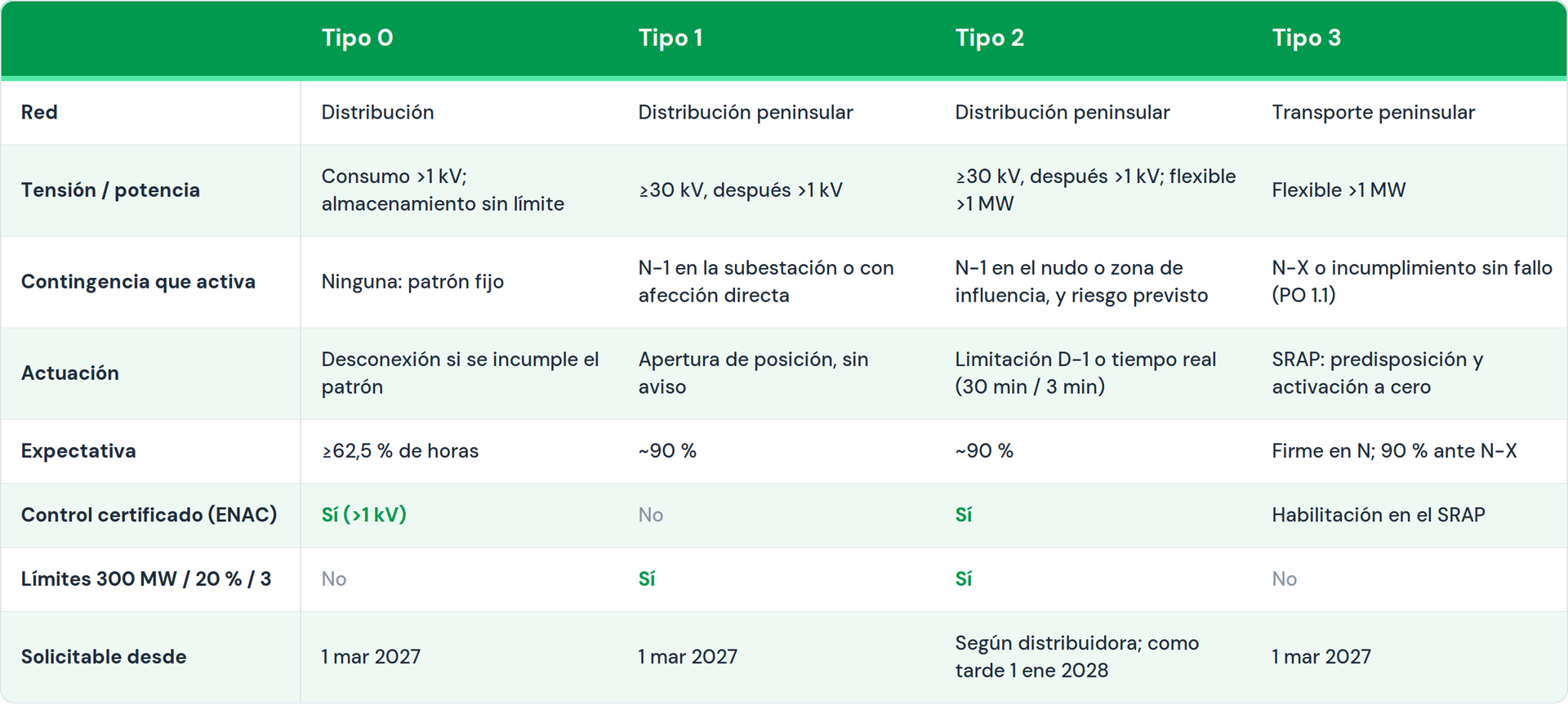
Type 0: limitations by time pattern
The most relevant particularities of Type 0 permits are:
- It only limits charging from the grid; discharging remains unrestricted. The provisional pattern (0.1) allows charging from 00:00 to 07:59 and from 11:00 to 17:59.
- It is the only route currently available for batteries below 30 kV.
- The batteries' local control must be ready to follow instructions such as those for Type 2.
Still pending:
- The final patterns (distribution companies' proposal expected before December 2026, with no defined deadline for approval).
- It is also unclear how the SIGPF will be certified between March 2027 and the arrival of ENAC's technical framework, expected in September 2027.
Type 1: remote disconnection in case of unavailability
The most relevant conditions of Type 1 permits are:
- It requires a dedicated substation bay, which can be shared if all permit holders accept the effects of disconnection in writing.
- Disconnection is total: in a hybrid, it also cuts discharging and the plant's export. Reconnection requires authorisation from the control centre.
- It does not require a SIGPF, but it does require the remote disconnection device defined by the distribution company and real-time telemetry.
Still pending:
- Defining who bears the cost of the dedicated bay.
- Resolving the clash with the firm permit for auxiliaries, since Type 1 cannot coexist with any firm permit at the same point.
Type 2: dynamic limitation by instructions
- It is the most flexible for market participation: the permit holder can reschedule within the limit communicated to it.
- If an instruction is not followed, the flexible load is disconnected first and, if non-compliance persists, the entire facility.
- In hybrids, instructions can be received at the connection point of the hybridised facility.
Still pending:
- Each distribution company's activation date and the technical note (September 2027).
- In addition, a medium-voltage battery could miss the priority conversion window if the threshold has not yet dropped below 30 kV when that window opens.
Type 3: automatic reduction in transmission
- REE first curtails generation, in reverse order of dispatch priority, and then Type 3 demand, on a rotating basis.
- Energy not consumed is settled at the day-ahead marginal price. Anyone failing to comply more than 2% of the time over a rolling year may be permanently removed.
- Until 2029, it is only allowed in a dedicated consumer bay.
Still pending: the reactive power requirements to be proposed by REE.
POD1 and the operational plumbing
The CNMC resolution approved the first Distribution Operating Procedure (POD1), the manual that allows distribution companies to operate flexibility in real time. It is the least eye-catching piece, but without it the Type 1 and Type 2 instructions would have no operational basis.
This POD lays the foundations for observability and controllability of flexible assets by distribution system operators.
- Real-time signals. Active and reactive power, voltage, status of the boundary-point breaker and status of the flexible load breaker, sent to a single distribution companies' platform via the generation and demand control centre.
- Order of action. The distribution company acts first on its own grid. It can then request technical constraints on the generation schedule and act on flexible facilities according to their permit.
- Operating protocol. Mandatory before the technical access contract. It includes operating and switching limits, normal and emergency regimes, action in case of non-compliance with criteria, restoration, and metering and instruction-reception requirements.
- Traceability. Every instruction, disconnection and reconnection is recorded in full and auditable form (date, time, duration, facilities affected and cause), available to the permit holder and the CNMC. In the future, we hope these instructions can also be made public, even if anonymised, as is the case with technical constraints data.
- Market integration. Permit holders can participate in the system operator's markets by reporting their permit type and, for Type 0, the pattern. Orders are communicated to the facility, its representative and REE. If the permit holder cannot correct its schedule in time, REE cancels it and values it at the day-ahead marginal price.
Assessment and impact on projects
What should storage developers do?
RDL 7/2026 amended the Electricity Sector Law so that access and connection permits for storage are considered flexible from the demand perspective, and its sixth transitional provision requires permits already granted to be adapted. The resolution sets out how in its fifth operative provision.
Distribution projects not in operation as of 1 September 2026:
- Once Types 0 and 1 are activated (1 March 2027), they have 3 months to request conversion of their demand permit to Type 0 or Type 1, with processing priority over new applications.
- If they do not adapt, they lose the exemptions under Article 1.3.b of RD 148/2021 (charges) and Articles 2.2.c and 2.2.d of Circular 3/2020 (network tolls), and become liable for the capacity reservation charge under Article 11 of RDL 7/2026.
- When the distribution company activates Type 2, they have a further 3 months, also with priority, to move from Type 0 or 1 to Type 2.
Distribution projects already in operation:
- They are considered flexible unless the permit holder expressly states otherwise, and they continue operating under the same conditions as before until flexible permits are effectively implemented.
- If they meet Type 2 requirements, they have 3 months from its activation to request conversion, with priority.
- If they do not adapt, they lose the same exemptions on network tolls and charges.
Common conditions for projects with access and connection permits already granted
The update requires a capacity study and evidence of compliance with technical, safety and control requirements, and it is processed as a modification of the permit, not as a new application. The Type 1 and Type 2 limits of 300 MW, 20% and 3 facilities do not apply to these batteries.
Transmission projects
All storage permits in transmission are considered flexible without conversion, and the conditions of those already in operation are not changed by this resolution.
How do flexible permits affect projects?
Economic impact
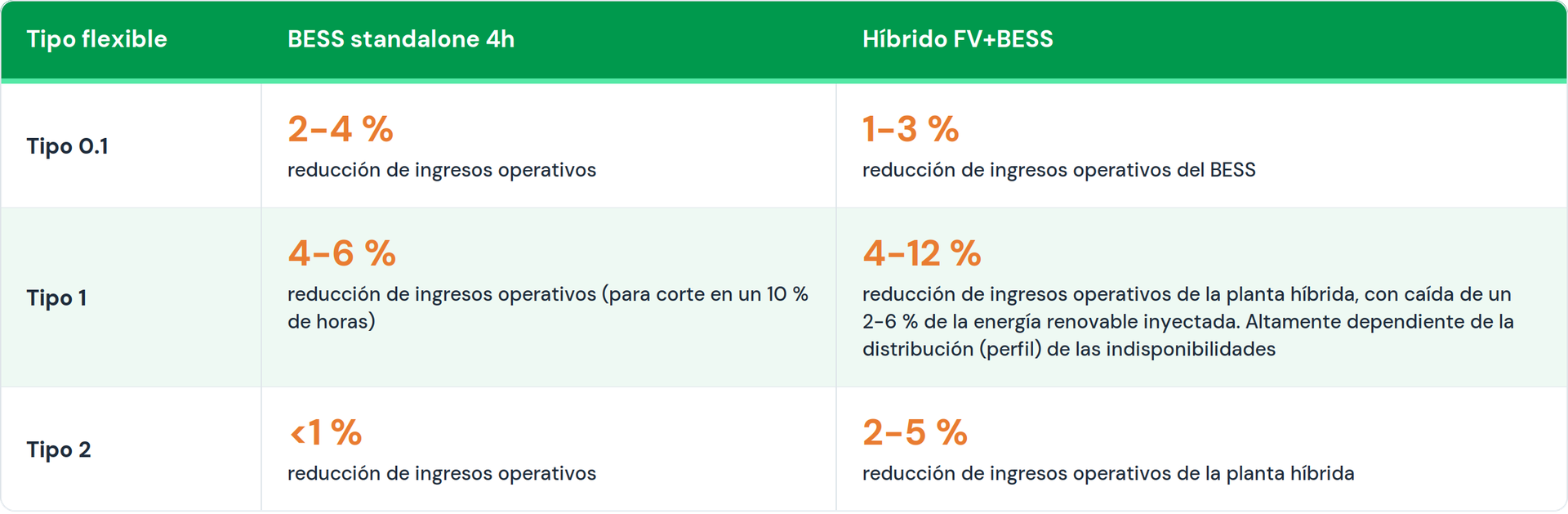
There is a common factor that is easy to understand for any type of flexible permit: moving from firm to flexible permits means lower merchant revenues.
The question is: how much does it affect each project?
And it is a hard one to answer, because:
- It depends on the zone and the connection node. The limitations of Type 1, 2 and 3 permits are driven by localised grid stress factors. Moreover, this information will, for now, be private. Only developers and grid operators will have access to it, making it very difficult to anticipate whether consumption is more or less likely to be limited at one node than at another. The analogy would be technical curtailment (RT1, RT5), although here the information is far more opaque.
- The effect on revenues or increase in operating costs depends on each facility. A consumption limitation does not have the same effect on revenues/costs for an industrial facility as for a battery storage system, nor the same effect on a 2-hour battery as on a 4-hour one.
- Even if no new market is opened, the consumption limitations that grid operators may apply at times of stress could have effects, still unknown, on intraday and ancillary services markets.
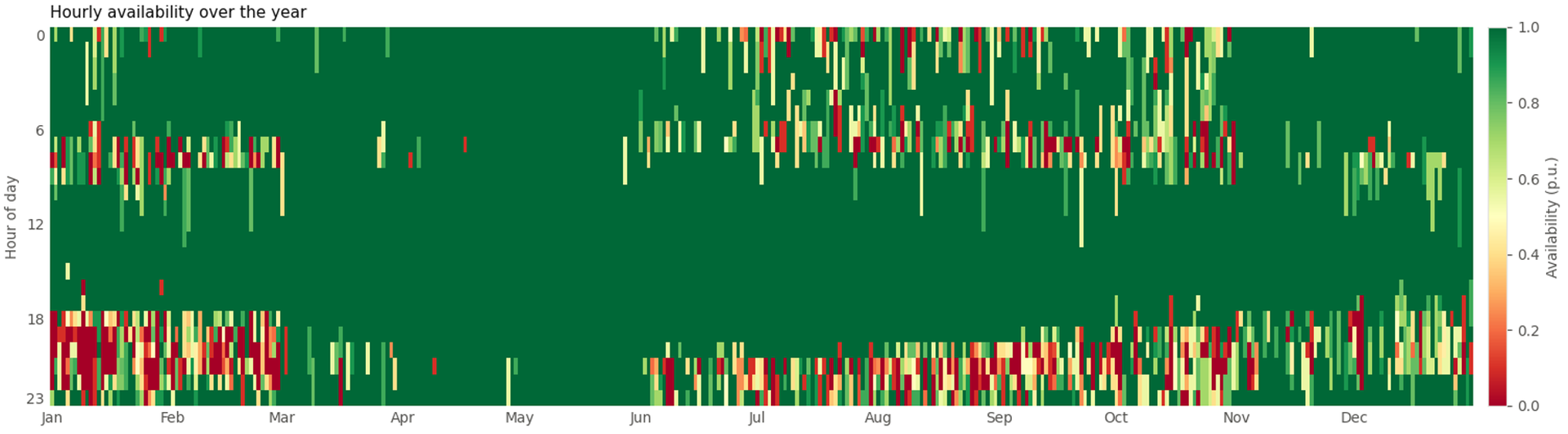
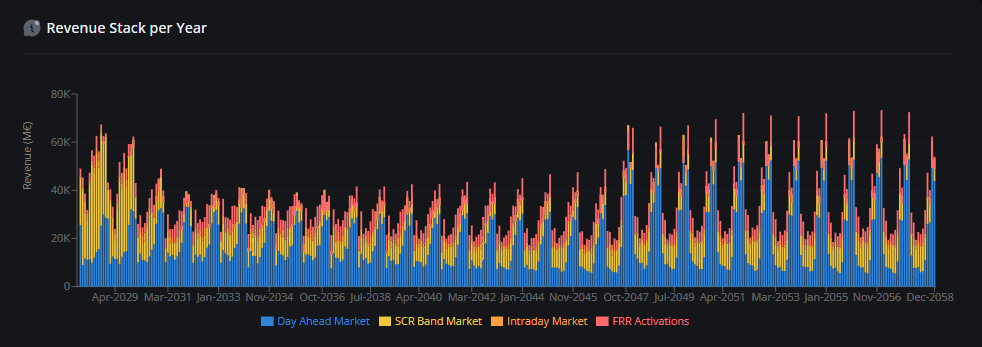
Example of a Type 2 profile with unavailability or limitations for 10% of equivalent hours. Profile generated for simulations on our SaaS platform One Hub Analytics for a specific node of the distribution grid.
Would you like to understand how flexible permits affect your project, and support its valuation in M&A or financing processes? Contact us.
Conclusions and open issues
What do flexible permits solve, and what do they not solve?
✓ What they solve:
- An access route where there was none: at a node without firm capacity, the alternative is no longer just refusal or waiting for reinforcement.
- A first step towards observability: the progression from Type 0 (local control) to Type 2 (D-1 and real-time instructions) acknowledges that distribution companies do not yet have real-time management tools.
- Coexistence of firm and flexible (Types 0, 2 and 3): base consumption can be firm and the modulable extension, flexible.
- Market integration: if a reduction prevents the schedule from being corrected, it is cancelled at the day-ahead marginal price. Energy not consumed is not charged, but this is a settlement adjustment, not compensation.
- Procedural certainty: the operator's counter-proposal does not cause loss of priority, and the minimum content of documents is set out.
- Traceability: an auditable record of every action, an annual report to the CNMC and independent certification of control systems.
✕ What they do not solve:
- Economic signal: there is no network tolls and charges methodology for flexible capacity. In the Netherlands, the tariff discount reaches 65%.
- Path to firm capacity: conversion from flexible to firm, which European legislation does provide for, is not regulated. Nor is conversion from firm to flexible allowed.
- Compensation: limitations do not give rise to compensation and do not count towards quality of supply.
- Telemetry outage: counts as non-compliance; the future resolution will set thresholds, tolerances and a tiered regime.
- Hybrids: in Type 1, all holders of the shared infrastructure must accept that a disconnection will prevent them from selling or buying energy. Type 3 does not apply to generation bays until 2029.
- Medium voltage: Types 1 and 2 are limited to 30 kV or above until POD1 is adapted and 12 months have passed (extendable by 6).
- Flexibility as a service: selling flexibility to the distribution company is left to future local markets.
- Pending details: final Type 0 patterns, allocation of reductions, penalties for non-compliance and publication of flexible capacity. These will come through later resolutions; in the meantime, legal uncertainty persists.
The CNMC also points to regulations outside its competence that will need to be amended (RD 1048/2013, RD 1183/2020, the contracting regime and RD 1110/2007), and suggests a comprehensive regulation on storage.
Some open questions on flexible permits
On priority and existing permits:
- How will these priority conversions fit into the queues each operator has open as of 1 March 2027?
- How will the priority of permits already granted be managed if one developer processes the change in March 2027 and another applies, still within the deadline, 2 months later?
- What happens if batteries already granted at a node exceed the concentration criteria? Will the capacity of batteries with prior permits that adapt to Type 1 or 2 count towards the concentration limits for new applicants at the same node?
- Applications in process and pending as of 1 March 2027 (submitted, not granted): no specific rule.
On capacity, maps and tenders:
- Public information: flexible capacity maps will be published using a methodology yet to be defined, and there will be an annual report to the CNMC. Unanswered: will permits granted by node and type, the annual report and/or limitation data by node be made public?
- Capacity listings: batteries count according to their type, and flexible permits according to their operating conditions. Unanswered: how much firm capacity will emerge, and when.
- Tender nodes: the resolution does not mention them; it is a grey area.
On transparency and signals:
- Visibility of disconnections: there will be an auditable record for the permit holder and the CNMC. Unanswered: whether there will be public information for third parties.
- Allocation of reductions: no rule until distribution companies propose one (within 6 months). For Type 3, P.O. 3.11 applies.
On operation and markets:
- Telemetry outage: counts as non-compliance; the future resolution will set thresholds, tolerances and a tiered regime.
- What happens if a distribution company misses the deadline to make Type 2 permits available before 1 January 2028?
On economic criteria:
- Network tolls for flexible capacity: still to be regulated.
Do you have questions about the regulation and/or how to get your storage project permitted? Contact us