How much storage can Spain’s power system hold? What official gazettes reveal
Using the Pulse Energy tool, we have analysed announcements published in the BOE (Spain’s Official State Gazette) and regional official gazettes to identify the storage projects under development in Spain.
By combining this information with Red Eléctrica data, we answer four questions:
- How much storage can the power system hold?
- Which BESS projects received public funding?
- How is hybridisation progressing?
- Which storage projects are already in operation?
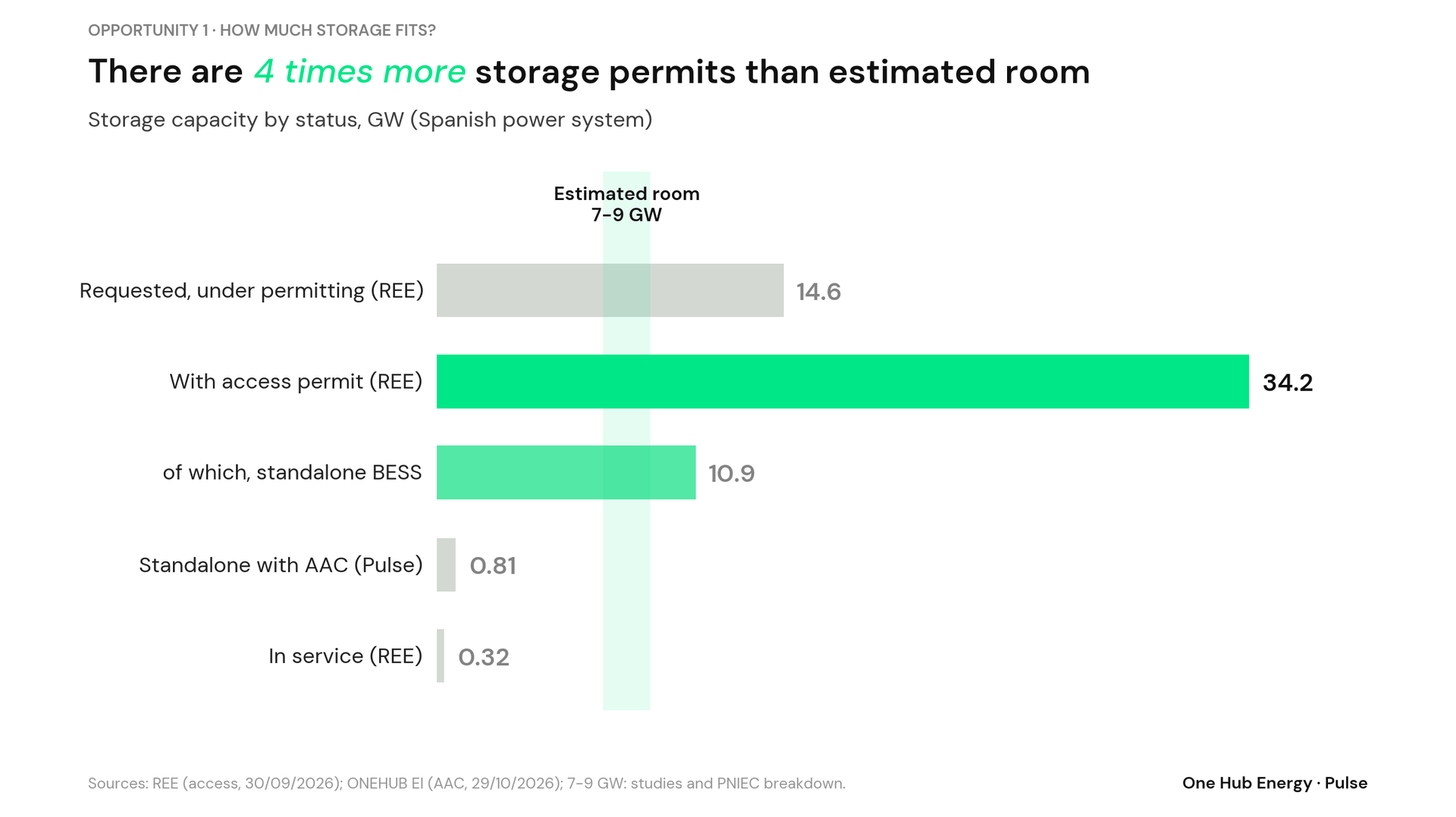
As of 30 September 2026, the Spanish power system had 34.2 GW of storage modules with grid access permits, according to data published by Red Eléctrica.
Industry estimates put the room for batteries in the system at around 7-9 GW.
And, according to the same data, storage capacity in service stands at 321 MW. The next stage of energy storage will be decided between those three figures.
This analysis is aimed at developers, investors and asset managers working with utility-scale storage. Technology, system needs and public support have set in motion an unprecedented project pipeline. The question now is how much of it will reach operation, and when.
What we see in official gazettes
Pulse Energy reads and classifies the announcements published by the BOE and regional gazettes at each stage of the permitting process: public consultation, environmental assessment, prior administrative authorisation and construction authorisation.
This systematic reading shows how fast the sector is accelerating. Official announcements for BESS projects of 1 MW or more rose from 7 in 2022 to 24 in 2023, 102 in 2024 and 220 in 2025. As of 28 October 2026, they already total 413 (Pulse Energy).
The most significant shift is in the hybridisation of renewable assets. In 2025, standalone batteries and hybridisation progressed more or less at the same pace. In 2026, hybridisation announcements (271) are almost double those for standalone batteries (142).
How much storage can the power system hold?
Spain’s National Integrated Energy and Climate Plan (PNIEC) sets a target of 22.5 GW of storage by 2030: 12.5 GW of daily and weekly storage and 10 GW of seasonal storage, including pumped hydro, solar thermal and batteries (MITECO).
At the end of 2025 there were 3,427 MW: 3,331 MW of pumped hydro and 96 MW of batteries (Red Eléctrica). That is, around 15% of the target.
The PNIEC does not set a specific figure for batteries. Current industry estimates put their room for installed capacity at around 7-9 GW, equivalent to roughly 30 GWh with four-hour systems. This is a reference for the market size the system could absorb, rather than a target.
Against that reference, the pipeline is far larger.
Red Eléctrica records 34.2 GW of storage modules with access permits and a further 14.6 GW being processed. Standalone batteries alone account for 10.9 GW with permits, more than half of them connected to the distribution grid.
At the other end of the process, Pulse Energy identifies 27 standalone batteries with construction authorisation, totalling around 0.8 GW, plus more than a hundred hybrid projects at the same stage.
In other words, there are roughly four times more storage permits than the estimated installed battery capacity. Of course, not everything with a permit will be built, so we can expect an intense selection of the projects that will eventually reach operation.
The permit map shows where this pipeline is concentrated. The main hubs for standalone batteries with access permits are in Catalonia, led by Begues and La Farga; along the Cantabrian coast, with Siero and Basauri; and on the Málaga-Almería axis, with Alhaurín and Berja. Applications currently being processed also point to new hubs in the Ebro valley and around Sagunto (Red Eléctrica).
How much will reach operation?
As mentioned above, not everything in the permitting process gets built. Looking at what happened with solar PV, we find that for every gigawatt that went to public consultation in 2019 and 2020, between 0.5 and 0.7 GW were installed five years later.
Applied to storage: if every project that goes to public consultation came into operation five years later, Spain would reach around 10 GW of batteries by 2031.
Applying the most conservative realisation rate observed in solar PV, the figure would be closer to 4.8 GW (Pulse Energy, One Hub Energy estimate). Only the unadjusted scenario fills the estimated installed capacity range, and not before 2031.
Funded projects: the clock is already ticking
The PINALM-FEDER call awarded €818.3 million to 126 projects out of 1,750 applications: roughly one in fourteen received funding. The beneficiaries will add 2.2 GW of power and 9.4 GWh of storage capacity: 69 hybrid projects, 39 standalone batteries, 15 thermal storage projects and 3 pumped hydro plants. Hybridisation receives 61% of the funding (IDAE, MITECO).
The regional breakdown reflects the budget allocated to each autonomous community according to its level of development. Andalusia hosts 31 projects and 43% of the funding, followed by Castilla-La Mancha, Galicia and Extremadura, with just over €90 million each (IDAE).
The timeline is demanding. Projects have 36 months from the final resolution, issued in December 2025, and may under no circumstances be completed after 30 September 2029 (IDAE). For most of them, 2027 will be the year they must move from authorisation to construction.
The call’s criteria rewarded project maturity: environmental impact statement, accredited grid access point, land use or building permit. This suggests the beneficiaries start from a relatively advanced stage. Even so, the public information available does not yet allow a rigorous estimate of how many will make it on time.
[CTA] Explore BESS projects under development in Pulse
Explore for free
Explore BESS projects under development in Pulse
Hybridisation as the way forward for solar PV
Among the 69 hybrid projects funded under PINALM-FEDER are 38 solar PV, 18 wind, 9 solar thermal and 4 combining solar PV and wind (MITECO). Red Eléctrica also records 14.0 GW of access capacity with permits for hybridisation and a further 3.2 GW being processed.
The geography of the announcements reinforces this reading. Hybridisation is concentrated in Castilla-La Mancha, Castilla y León, Aragón and Extremadura, home to a large share of the solar PV fleet. Standalone batteries, by contrast, stand out in Asturias, the Canary Islands and Catalonia, often with smaller projects connected to the distribution grid (Pulse Energy).
The logic is clear: an operating plant already has grid access, a production history and curtailment data, and adding a battery at the same connection point is a lower-risk step.
Wind is starting to follow the same path. The BESS Los Pedreros file, published in the BOE in October 2026, requests the addition of 25.08 MW of batteries to an existing wind farm.
There is ample room for growth, because the solar PV pipeline being processed is also large. If all the capacity that has gone to public consultation since 2021 came into service five years later, it would add around 72 GW by 2031, well above the observed installation rate. With the same conservative realisation rate, the estimate is around 34 GW (Pulse Energy, One Hub Energy estimate).
For solar PV assets not yet in operation, parallel hybridisation remains the exception. It is an opportunity for those able to permit both components at once and reach commissioning with the battery already authorised.
Which assets are already in operation?
At the end of 2025, Red Eléctrica counted 96 MW of batteries in the system. Its access data as of 30 September 2026, a different source that records the status of each permit, already shows 321 MW of storage modules in service, spread across 20 nodes.
The most revealing figure is the project type: of those 321 MW, only 16 MW correspond to standalone battery access capacity. Almost all BESS projects in service are hybridised with generation plants, confirming the trend shown by the gazettes.
Measuring operation requires other sources. Commissioning rarely appears in official gazettes, which is why Red Eléctrica’s operational data, such as the i90 unit scheduling file, are the reference for knowing which batteries are actually running. Cross-referencing the administrative pipeline with that data is the step that completes the full journey: from the gazette announcement to the energy delivered.
2027 outlook: a year of selection and execution
Our forecast for 2027 is specific. Hybridisation of existing plants will continue to lead entry into operation. Projects funded under PINALM-FEDER will have to make their construction decisions to meet their deadlines. And the gap between permits and available room will mean that only projects with adequate grid connection, financing and a well-defined revenue strategy will move forward.
In 2027, the figure that will draw the most attention will be how much of the developed pipeline finally starts working for the system.
Follow the evolution of battery storage in Spain with Pulse Energy.
Frequently asked questions
How many batteries are installed in Spain?
At the end of 2025, Red Eléctrica counted 96 MW of batteries. Its access data as of 30 September 2026 shows 321 MW of storage modules in service, mostly hybridised.
How much storage does the PNIEC foresee for 2030?
22.5 GW, of which 12.5 GW is daily and weekly storage and 10 GW seasonal, including pumped hydro, solar thermal and batteries. At the end of 2025 there were 3,427 MW.
How many battery projects are in the permitting process?
Red Eléctrica records 34.2 GW of storage modules with access permits. Pulse counts 413 official announcements for BESS projects of 1 MW or more in 2026, up to 28 October, and around 0.8 GW of standalone batteries with construction authorisation.
When must PINALM-FEDER funded projects be completed?
Within 36 months of the final resolution of December 2025 and, in any case, before 30 September 2029.
Methodological note: Pulse counts reflect announcements for projects of 1 MW or more published in the BOE and regional gazettes, based on their document coverage and classification; a single project may generate several announcements. Annual series cut off at 28/10/2026; construction authorisations and nodes consulted on 29/10/2026. Red Eléctrica access data are as of 30/09/2026 and include transmission and distribution grids. The 7-9 GW range is an industry estimate, not an official target. Projections to 2031 and their adjustment are One Hub Energy estimates.